
Nicolas de Condorcet, the marquis who wanted every vote to count.
Condorcet (1743-1794) was the first to prove that a vote can betray the will of those who cast it, and to look for a way to prevent it. Condorcet.Vote bears his name. Here is why.
- Mathematician
- Enlightenment philosopher
- Voting theorist
- Economist
- Encyclopedist
- Revolutionary deputy
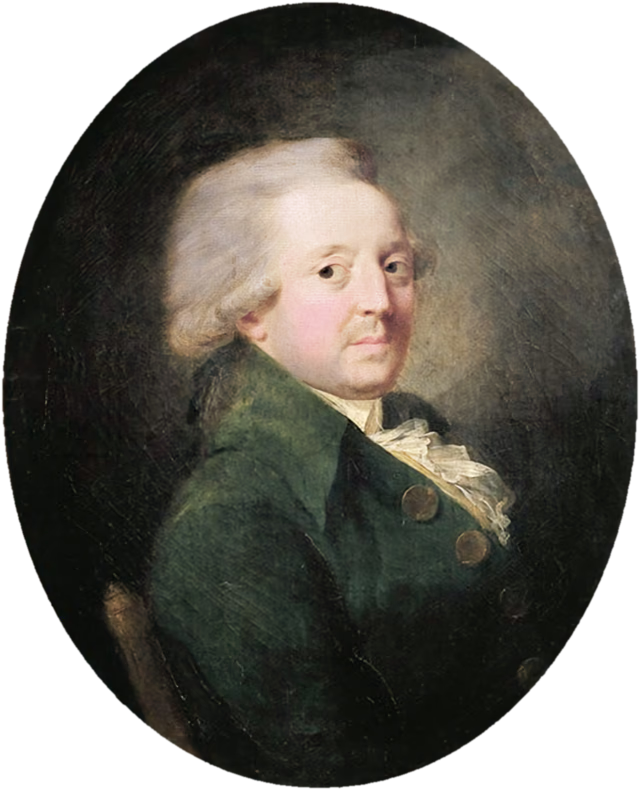
Putting reason, and calculation, to work on human affairs.
His father died when he was a month old; he was schooled by the Jesuits, whom he remembered bitterly. Condorcet defended his mathematics thesis at 16 under d'Alembert's eye, and turned down the military career his family had planned for him. At 25 he entered the Academy of Sciences, of which he would become permanent secretary.
A friend of Voltaire, adviser to Turgot at the finance ministry, inspector of the Mint, he belonged to the generation that wanted to apply the scientific method to society: the economy, justice and, soon, the way people decide together.
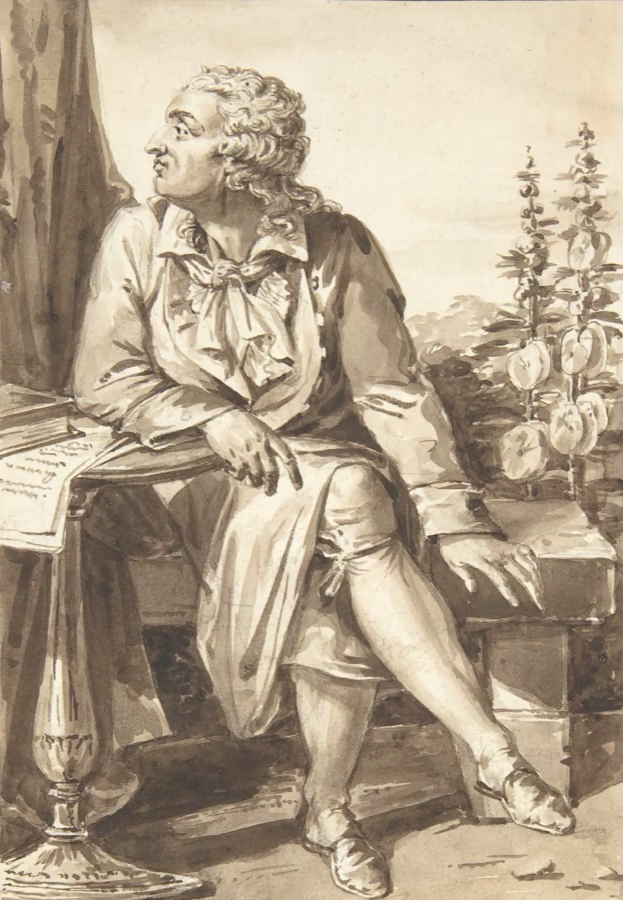
The first to prove that a vote can get it wrong.
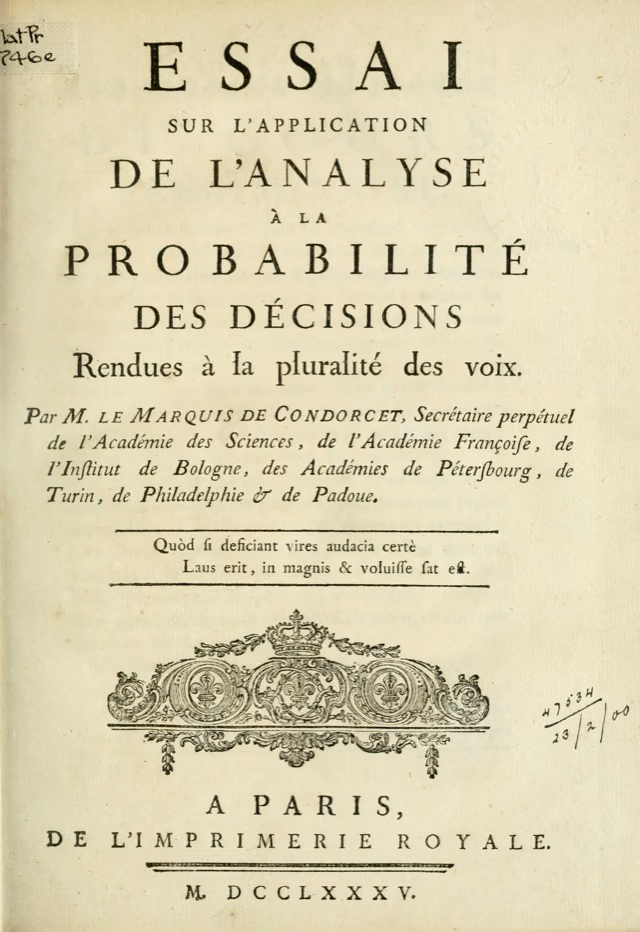
In his “Essay on the Application of Analysis to the Probability of Majority Decisions”, Condorcet asks a question no one had treated so rigorously: does an assembly that votes really express its will? His answer fits in one example, still quoted today.
60 voters, three proposals A, B and C. Under first-past-the-post, A wins with 23 votes.
- A 23 · elected
- B 19
- C 18
- A , then C , then B 23 voters
- B , then C , then A 19 voters
- C , then B , then A 16 voters
- C , then A , then B 2 voters
Yet, compared one by one, A loses every duel: 35 voters prefer B, 37 prefer C. And C, last on first choices, beats every other option. His rule: elect the option that wins each of its duels, the “Condorcet winner”.
The same essay proves the “jury theorem”: if each voter has slightly better than even odds of judging right, the collective decision is all the more likely to be right as voters grow in number. A mathematical case for collective deliberation.
Condorcet himself thought his method hard to apply at scale: counting every duel of thousands of ballots by hand was out of reach. He lacked a computer. That is exactly what Condorcet.Vote does, with the modern methods (Schulze, Ranked Pairs) that settle even the cycles where no winner emerges, the famous “Condorcet paradox”.
Ideas that have not aged a day.
A reformer, not an idealist.
Condorcet was no firebrand. A liberal raised on the physiocrats, he stood with Turgot for free trade in grain against Necker's state control. A legalist, he distrusted insurrection and preferred a managed transition to the monarchy's sudden fall. In 1791 he accepted a post at the National Treasury on the king's appointment, which would be held against him, and he knew how to change his mind when circumstances required, on paper money for instance.
Counted among the Girondins without taking up all their quarrels, he stood for a republic of reason: revisable laws, equal citizens, power held in check. To him no law is sacred: it is learned, debated and corrected.
“The aim of instruction is not to make people admire a ready-made legislation, but to make them capable of appraising and correcting it.”
A vote result is no different: you are not asked to believe it, but to be able to check it.
A victim of his own theories.
In February 1793 he laid his draft constitution before the Convention: a secular republic, revisable laws, referendums and popular initiative. It was set aside for a Montagnard text drafted in haste, which Condorcet publicly denounced.
A tragic victim of his own political theories: his death was voted democratically by the National Convention. On 8 July 1793 it decreed his arrest; in those days, being indicted was a one-way ticket to the guillotine.
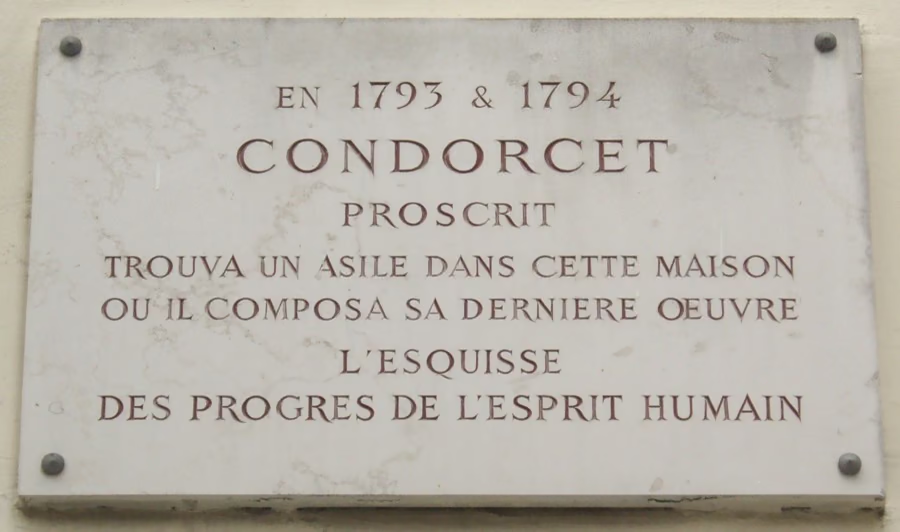
Hidden for nine months on rue Servandoni in Paris, he wrote the “Sketch for a Historical Picture of the Progress of the Human Mind”: a hymn to progress, written by a hunted man. On 25 March 1794 he fled. At an inn in Clamart, he reportedly ordered a twelve-egg omelette, a detail found suspicious. Arrested, he was found dead two days later in his cell at Bourg-l'Égalité, the revolutionary name of Bourg-la-Reine. The cause of his death has never been established.
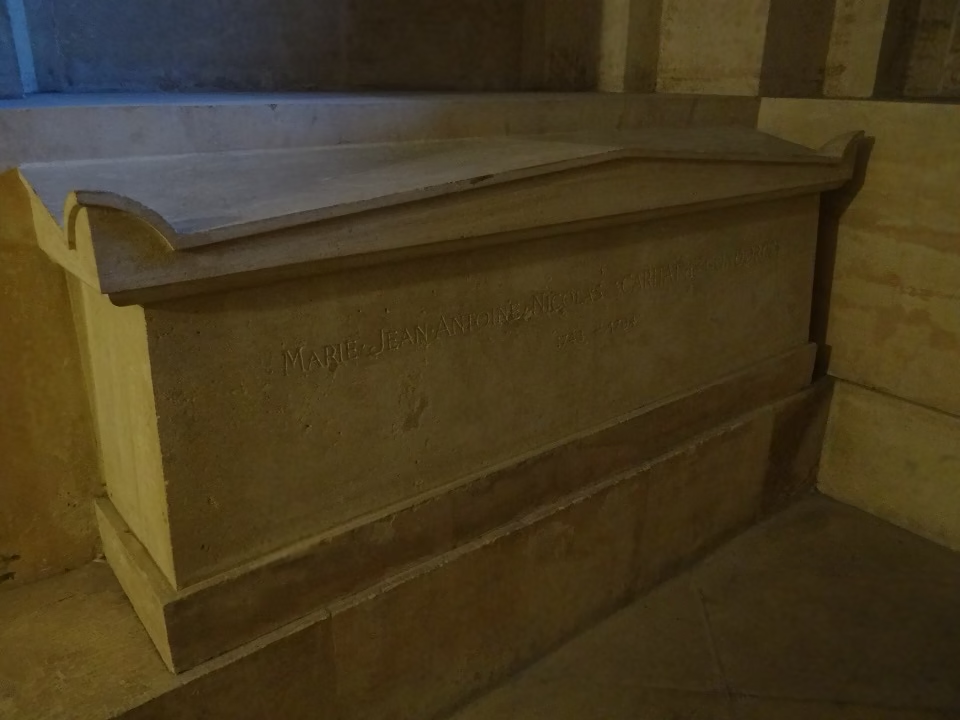
In the Panthéon, in an empty coffin.
In 1989, for the bicentenary of the Revolution, Condorcet entered the Panthéon. Symbolically: buried in the common grave of Bourg-la-Reine, his body was never found. Schools, streets and a campus bear his name. And now a voting platform, which counts votes the way he meant them to be counted.
Sources
| Type | Reference | What it establishes |
|---|---|---|
| Encyclopedia | Nicolas de Condorcet French Wikipedia | The thread of this biography, its dates and facts. |
| Primary source | Essai sur l'application de l'analyse à la probabilité des décisions rendues à la pluralité des voix Condorcet (1785) · Imprimerie royale | The 60-voter example and the jury theorem. |
| Primary source | Sur l'instruction publique, premier mémoire Condorcet (1791) · Œuvres, Didot, 1847, t. 7 | The quotation on laws to be appraised and corrected. |
| Documentation | CondorcetPHP Julien Boudry · GitHub | The recomputation of the Essay's example. |
Vote the way Condorcet would have wanted.
Rank the options, let the duels decide, check the result. Two centuries on, computers finally do the maths.